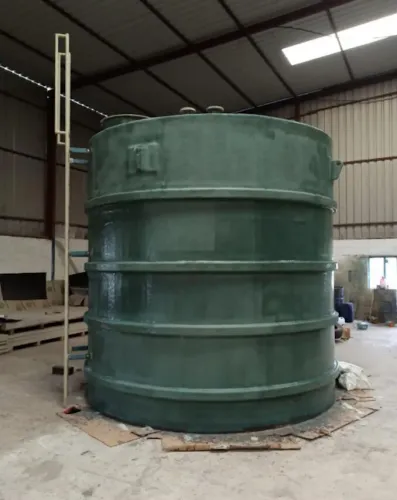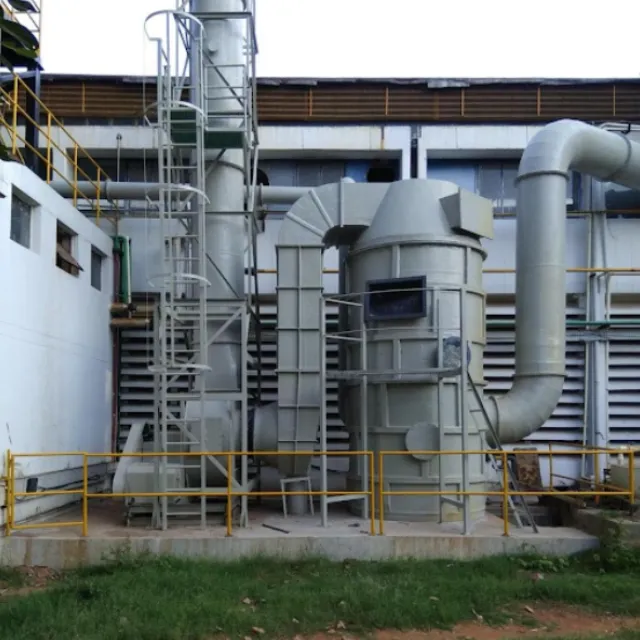
Industrial processes involving acids and reactive chemicals can generate fumes that should not simply be transferred from the production area to the outside atmosphere. A Fume Scrubber is used to treat contaminated exhaust air before it is discharged through the ventilation system.
This makes scrubber design particularly relevant to electroplating facilities, PCB manufacturers, chemical processing areas, jewellery units, metal finishing plants, and other industries using wet chemical processes.
What a Fume Scrubber Does
A Fume Scrubber receives contaminated air from extraction points such as process tanks, chemical workstations, or fume cupboards.
Inside the scrubber, the contaminated air comes into contact with a suitable scrubbing medium. The system is designed to capture or neutralise targeted contaminants before the treated air continues toward the exhaust outlet.
The actual treatment mechanism depends on the contaminant involved.
Important Parts of a Scrubbing System
A complete system may include several components rather than only the scrubber body.
These can include:
- Extraction hoods
- Ducting
- Scrubber vessel
- Packing media
- Spray arrangement
- Recirculation tank
- Pump
- Mist eliminator
- Exhaust blower
- Stack
- Chemical dosing arrangement
Each component needs to be sized with reference to the complete airflow requirement.
Why Contaminant Identification Comes First
Different manufacturing processes produce different fumes. Consequently, selecting a scrubber merely by physical size or motor capacity is not enough.
Engineers need to understand the chemicals used, expected concentrations, exhaust volume, operating temperature, process duration, and treatment objective.
The material used to construct the scrubber must also withstand the chemical environment. PP, PPH, PVC, or FRP may be considered for many corrosive applications depending on compatibility.
Extraction Capacity Needs Proper Calculation
An undersized system may struggle to capture fumes effectively. An unnecessarily oversized arrangement can increase energy use and operating costs.
Airflow calculations should begin at the emission source. Tank dimensions, hood arrangement, duct length, bends, pressure losses, and treatment equipment all affect the final blower requirement.
This system-level approach is particularly important in plants with several tanks connected to one extraction network.
Scrubbing Liquid Requires Management
The recirculating liquid used within a wet Fume Scrubber does not remain effective indefinitely.
Depending on the process, operators may need to monitor parameters such as concentration, pH, liquid level, contamination, and chemical condition.
Pumps, spray nozzles, packing, mist eliminators, and tanks also require periodic inspection.
Integration Improves Overall Fume Control
The most effective installations treat extraction and scrubbing as one coordinated system.
A high-capacity scrubber cannot compensate for poorly designed collection hoods. Similarly, effective extraction at a tank cannot deliver the intended environmental control when downstream treatment is unsuitable.
Industrial facilities around Bengaluru and Karnataka often operate multiple chemical processing stages within limited production areas. This makes coordinated engineering particularly valuable.
Associated Surface Innovators develops fume exhaust and scrubbing systems alongside surface treatment equipment, allowing extraction requirements to be considered in relation to processing equipment.
A Fume Scrubber performs best when contaminant characteristics, airflow, material compatibility, treatment chemistry, maintenance access, and exhaust routing are evaluated together from the beginning of the project.
Keywords