
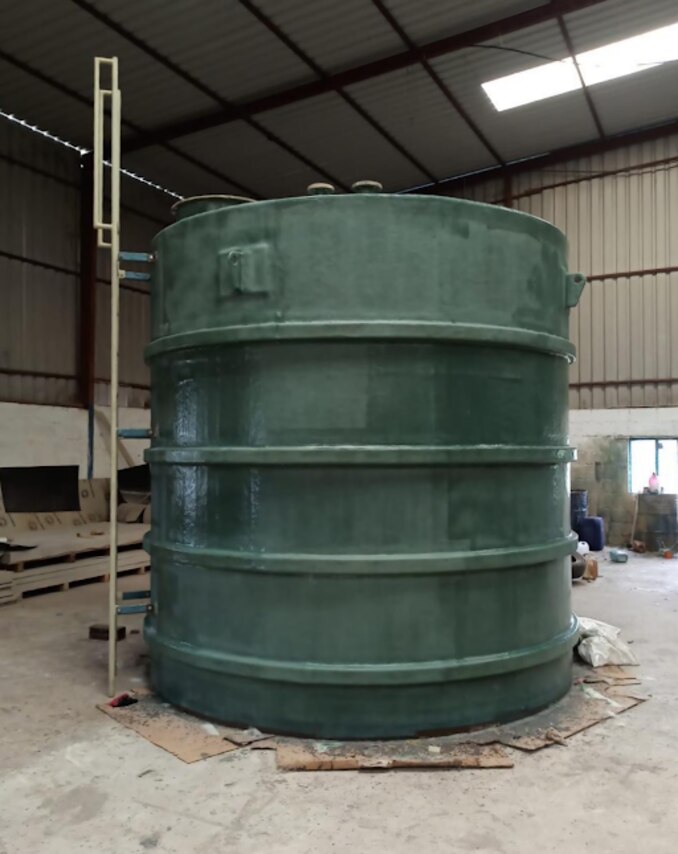
An FRP tank is not chemically resistant simply because it contains glass fibre: the resin, corrosion barrier, temperature, concentration and loading determine whether it will survive service. By the end, you will be able to screen chemical compatibility, compare FRP with alternative materials and specify the design checks that separate an atmospheric storage tank from a process vessel.
Key takeaways
- Match the resin and corrosion barrier to the chemical and operating temperature.
- Use thermoplastic liners when bare FRP lacks chemical resistance.
- Compare FRP with HDPE, PP, PVC, PVDF and stainless steel by service conditions.
- Specify atmospheric, vacuum, hydrostatic and process loads before fabrication.
How the FRP Tank Wall Handles Chemical Service
What is FRP? It is a fibre-reinforced polymer laminate: a thermoset resin system in FRP tanks combined with glass fibre reinforcement. The glass carries tensile and bending loads; the cured resin binds it, transfers stress and forms the continuous surface.
A tank may also have an external structural laminate, stiffening ribs, supports and fittings, but those parts are not the primary chemical shield.
| Layer | Job | What the liquid should contact |
|---|---|---|
| Corrosion barrier | Resin-rich inner layers and surface veil | Cured resin, not bare glass |
| Structural laminate | Glass fibre reinforcement carries pressure and handling loads | It should remain behind the barrier |
| Outer structure | Adds stiffness and protects against external damage | The outside environment, not process liquid |
The corrosion resistance comes mainly from the resin at the wetted surface, not from the glass. Porosity, poor cure, impact or excessive grinding can expose fibres, allowing wicking, blistering and delamination.
Ask whether construction follows ASTM D3299 filament winding or ASTM D4097 contact moulding, and request the barrier thickness, resin identity, cure evidence and inspection records. The manufacturing route changes laminate control and the evidence available, but neither standard makes an unsuitable resin compatible.
Match the Resin and Corrosion Barrier to the Chemical
FRP chemical compatibility is established from the actual chemical and operating cycle, not from the tank material name alone. Confirm the resin, glass architecture, corrosion barrier and temperature rating against the complete service description before fabrication. A chart screens options; written confirmation from the fabricator closes the decision.
Provide these details for each service:
- Chemical name and concentration, including plating additives, contaminants and cleaning agents
- Normal, maximum and upset temperature
- Specific gravity and whether the liquid is aerated, agitated or pressurised
- Vapour exposure above the liquid line
- Batch duration, continuous exposure time and hot-and-cold cycling
- Outdoor exposure, ultraviolet light and chemical spills on the exterior
Vinyl ester resin is commonly selected for stronger acids, oxidizers and elevated temperatures, but it is not universally resistant. Solvents and alkaline solutions can attack a particular vinyl ester; novolac vinyl ester or a thermoplastic lining may suit a harsher combination.
Obtain confirmation for the exact concentration and temperature, not a generic acid or solvent rating.
For aggressive service, inspect the corrosion barrier specification more closely than the structural laminate. Resin-rich layers with a surface veil protect the glass; poor cure, porosity, damage or excessive grinding exposes fibres, allowing liquid wicking and rapid laminate attack.
A tank suitable at ambient temperature can blister, crack or delaminate after heating, contamination or repeated thermal cycling. Check the barrier, liquid line, bottom, supports and nozzles during service inspections.
FRP Compared With HDPE, PP, PVC, PVDF and Stainless Steel
FRP is the better choice for large, stationary tanks handling corrosive liquids when low weight, fabricated shapes and resistance to general corrosion matter more than high mechanical strength or conductivity. The resin, corrosion barrier, glass reinforcement, temperature and process cycling still determine suitability; “FRP” is not one universal chemical-resistant material.
| Option | Main advantage | Choose it when |
|---|---|---|
| FRP vs HDPE | Rigid, lightweight and readily fabricated for large tanks | You need corrosion resistance, covers, sumps or complex fittings; choose HDPE for simpler, impact-tolerant tanks at moderate temperatures |
| FRP vs PP | Better structural stiffness and large-tank fabrication | You need a reinforced structure; choose PP for compatible chemicals and higher-temperature service than HDPE permits |
| FRP vs PVC | Stronger self-supporting construction | You need a tank rather than pipe or a small vessel; choose PVC for smaller, cooler, rigid-lined applications |
| PVDF-lined FRP tank comparison | A PVDF wetted surface adds resistance to aggressive chemicals | Select it when the chemical exceeds the bare resin’s compatibility; confirm liner seams, temperature and permeation |
| Stainless steel | High mechanical strength and conductive construction | Choose it for pressure, impact, cleanliness or heat service that the laminate cannot safely withstand; verify chloride and acid corrosion first |
FRP is the wrong choice when concentrated chemicals, solvents, hot spots or cleaning agents attack the selected resin, or when pressure, vacuum, impact or rapid thermal cycling controls the design. Obtain written confirmation for the exact mixture, concentration, temperature and cycle rather than relying only on a chart.
Treat the tank wall as containment, not secondary containment. Specify a compatible bund, isolated drain, leak detection and sump sized for the credible release; address static dissipation separately for flammable liquids.
Choose Bare FRP or a Thermoplastic-Lined Construction
A liner earns its complexity when the chemical is too aggressive, pure, or contamination-sensitive for the selected resin barrier, yet the FRP shell remains the practical structural material. Do not choose by chemical name alone: confirm concentration, temperature, residence time, cycling, oxidizers, solvents, cleaning agents, and fittings with the fabricator.
| Option | What it means | When it applies |
|---|---|---|
| Bare FRP tank | The resin-rich corrosion barrier is also the wetted surface | Choose it when the verified resin handles the full chemical cycle and the geometry benefits from fewer seams and welds |
| PVC plus FRP | PVC provides the wetted barrier; FRP supplies stiffness and load capacity | Use it for compatible acids, salts, and process liquids at temperatures within PVC’s rating, especially when contamination control matters |
| PVDF plus FRP | PVDF provides a higher-performance thermoplastic contact layer over an FRP structure | Select it for more demanding chemical mixtures, oxidizing service, or purity requirements when written compatibility confirmation supports the choice |
Thermoplastic liner selection adds welding, seam inspection, thermal-expansion control, and attention to liner support at nozzles and manways. A poorly fabricated liner creates leaks behind an apparently sound shell.
Keep bare FRP when the resin barrier is demonstrably compatible and the tank has complex penetrations, vacuum exposure, or process cycling that could strain a liner. Choose PVC plus FRP or PVDF plus FRP only after checking liner temperature, pressure, permeability, weld quality, and repair method.
Specify the Tank for Atmospheric Storage or Process Loads
Before ordering, classify the vessel as atmospheric storage or a process vessel and issue a written design basis. State liquid level, tank diameter and height, hydrostatic head and specific gravity, operating and cleaning temperatures, pressure or vacuum, cycle frequency, and agitation or heating equipment.
- Specify vacuum rating and vent sizing for pump-out, blocked vents, rapid cooling and steam-cleaning. A tank intended only for atmospheric service can collapse under external pressure.
- Calculate FRP tank nozzle loads from connected piping, valves, pumps, thermal expansion and equipment weight. Include flexible connections, sliding supports and independent pipe supports.
- Define local heat input, such as immersion heaters or steam coils. FRP’s low thermal conductivity reduces heat loss but does not prevent resin damage from hot spots.
- State containment volume, compatible floor and sump materials, leak detection, drainage isolation and inspection access. The tank wall is not secondary containment.
- Assess static control for low-conductivity or flammable liquids, including bonding, conductive construction, transfer velocity and hazardous-area requirements.
Check the principal design difference before selecting the construction:
| Item | Atmospheric storage | Process duty |
|---|---|---|
| Pressure | Near atmospheric; protect against vacuum | Include positive pressure, vacuum and cycling |
| Temperature | Bulk liquid and ambient range | Bulk temperature, hot spots and heat-up rate |
| Loads | Liquid head and support loads | Liquid head plus agitation, piping, thermal and nozzle loads |
Provide this complete basis to Associated Surface Innovators so the fabricator can verify laminate thickness, supports, nozzles, vents and heating details rather than infer them from tank capacity.
Related products
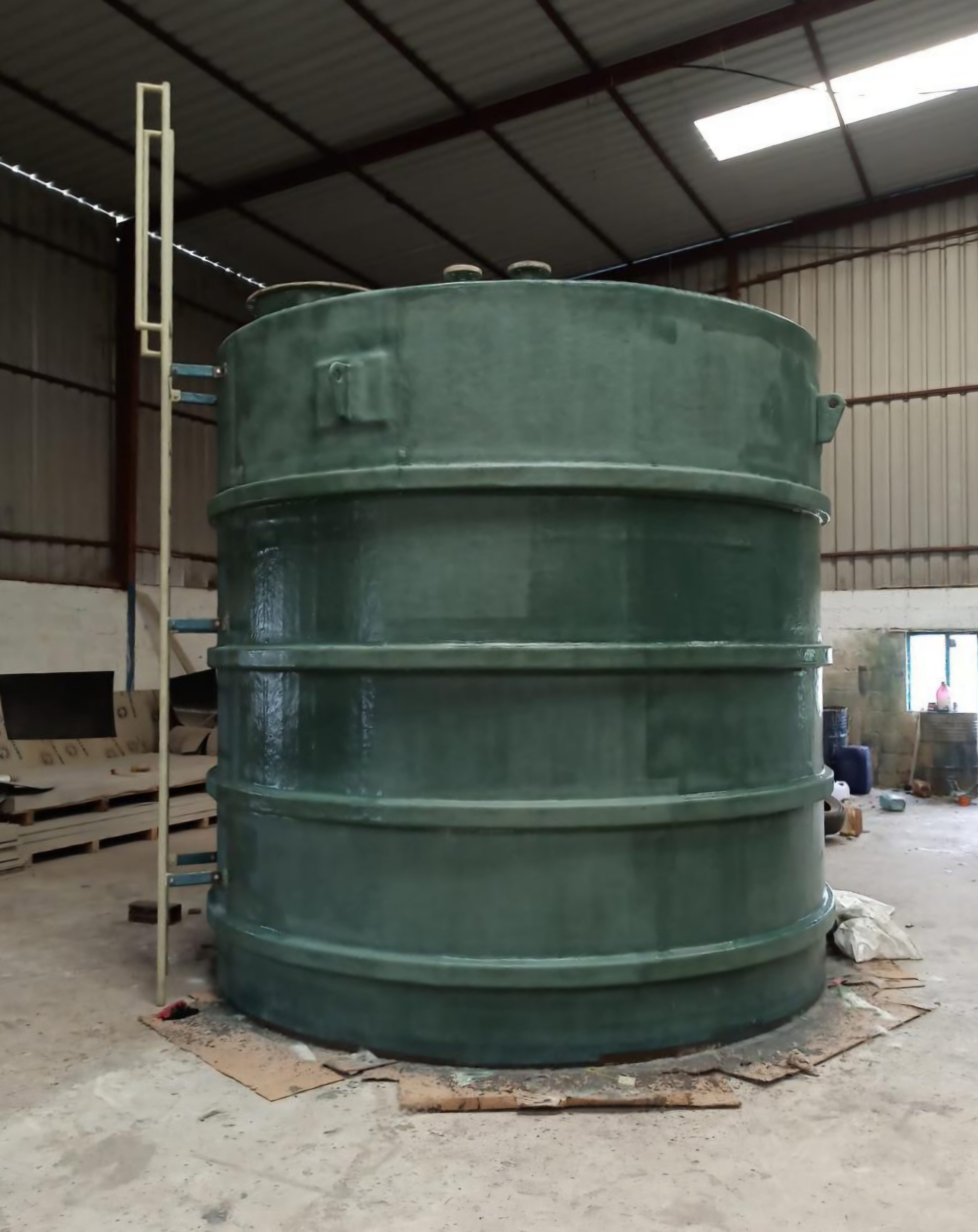 | Storage Tank Our FRP Tanks are designed to provide reliable and long-lasting storage solutions for a wide range of industrial applications. View product → |
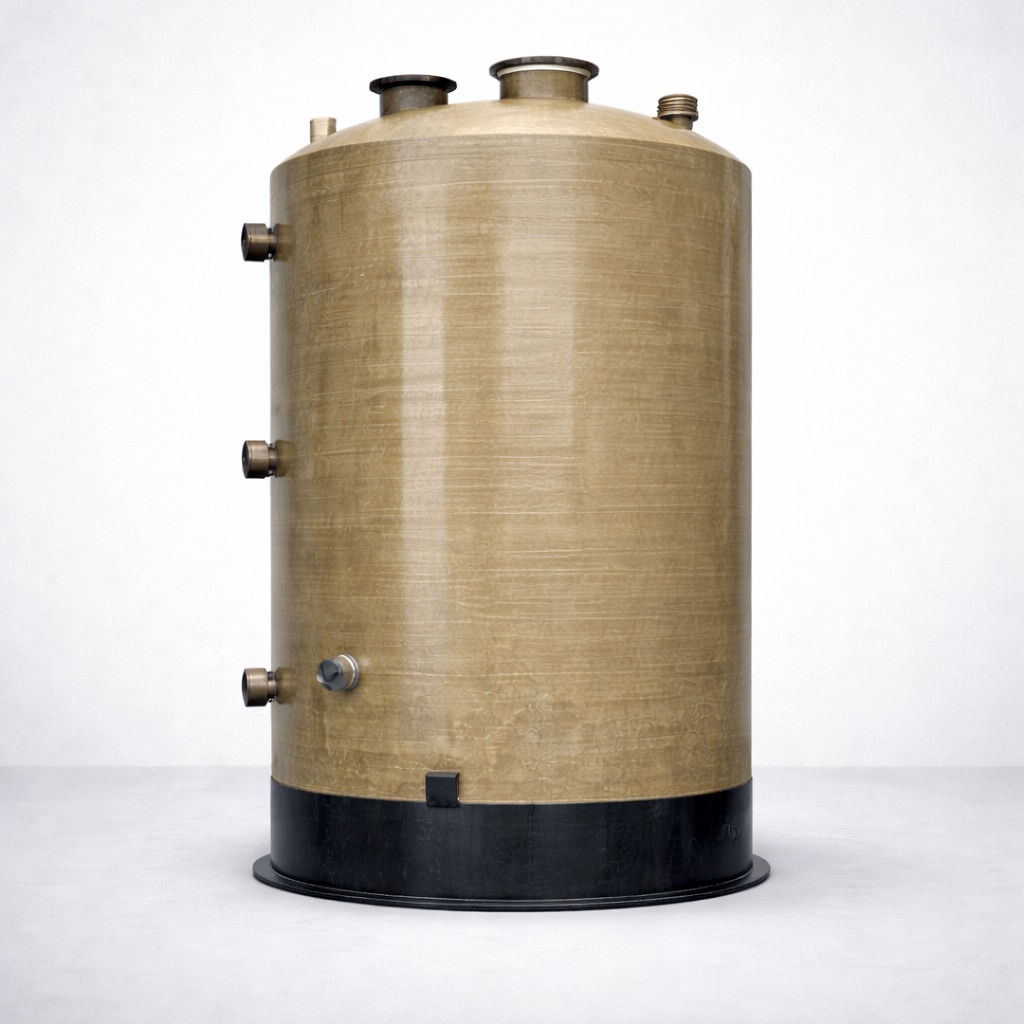 | PVC Tank We are a leading PVDF + FRP Tank manufacturer, specializing in the design and fabrication of high-performance storage tanks for demanding industrial... View product → |
Frequently asked questions
How does an FRP tank wall handle chemical service?
Glass fibre carries tensile and bending loads, while cured resin binds the reinforcement and forms the continuous chemical-contact surface.
How do you match FRP resin and corrosion barrier to a chemical?
Check the chemical concentration, temperature, exposure time and operating conditions against the resin and corrosion-barrier compatibility data.
How does FRP compare with HDPE, PP, PVC, PVDF and stainless steel?
The best material depends on chemical compatibility, temperature, mechanical loads, permeability, fabrication limits, maintenance and total service life.
When should you choose a thermoplastic-lined FRP tank?
Choose a lined construction when the thermoplastic provides the required chemical resistance and the FRP shell supplies structural strength.
What loads must an FRP tank specification include?
State whether the tank serves atmospheric storage or processing, then define liquid level, density, temperature, vacuum, pressure, agitator and connected-piping loads.
Related product
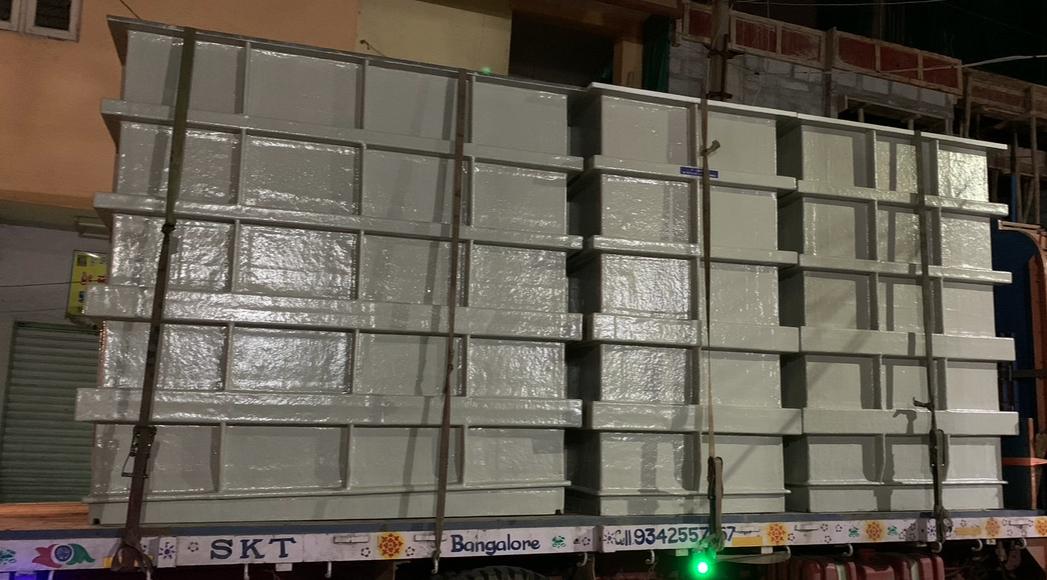 | PVC Tank We are a trusted manufacturer of high-quality PVC + FRP tanks, designed to provide reliable and long-lasting storage solutions for various industrial... View product → |





