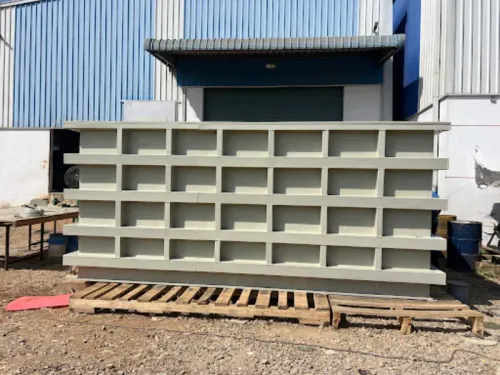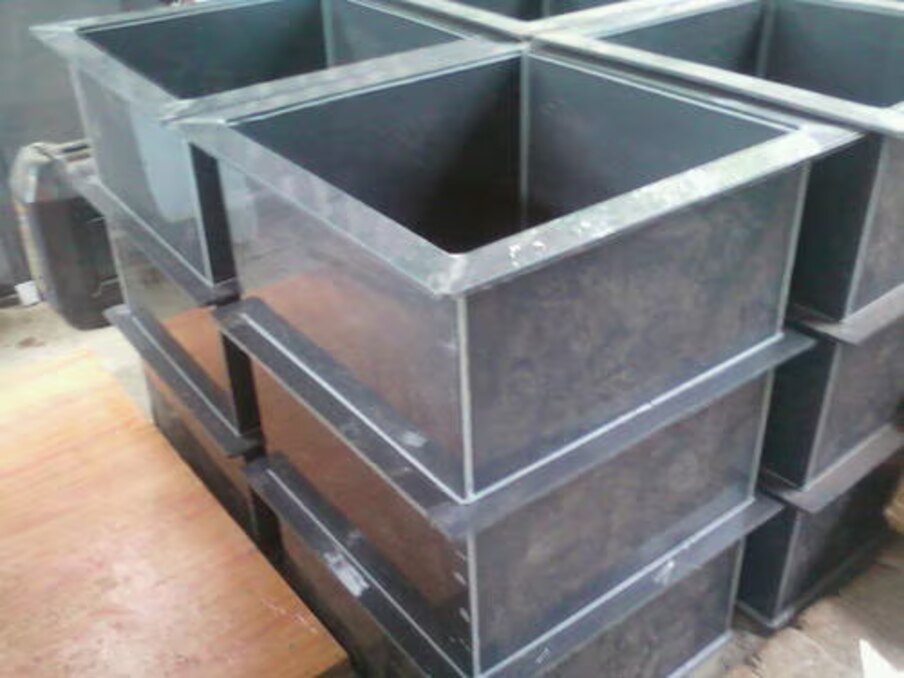
A PVC tank supports more than liquid storage: it can form part of a system for transfer, dosing, rinsing, mixing, heating, fume control and spill containment. By the end, you will be able to test chemical compatibility, define the operating loads, specify construction details and decide when PVC is the wrong material or needs structural reinforcement.
Key takeaways
- Check chemical concentration, temperature and exposure time against a manufacturer compatibility chart.
- Specify tank dimensions, wall thickness, supports, nozzles, vents and overflow routes before fabrication.
- Choose PVC plus FRP when structural loads or elevated temperatures exceed unsupported PVC limits.
- Inspect tanks, seams, fittings and supports for swelling, cracks, leaks and chemical damage.
What does corrosive chemical handling include beyond storage?
A PVC tank in corrosive chemical handling must perform a process duty, not merely hold liquid. Chemical storage needs a vented bulk tank, while chemical transfer needs compatible piping, pump suction and overflow routing that will not siphon or spill.
| Duty | What the tank must provide | Main design concern |
|---|---|---|
| Bulk storage | Containment for inventory | Venting, level indication and secondary containment |
| Day or transfer vessel | Short-term supply and movement | Reliable suction, drainability and connected piping |
| Dosing or mixing tank | Metered withdrawal or controlled agitation | Calibration access, agitation and residue-free drainage |
| Rinse or pickling tank | Clean, segregated process baths | Separate rinse lines, overflow elevation and freeboard |
| Electroplating tank | A working electrical process cell | Anode, cathode, bus bar, heater and rectifier clearances |
| Wastewater or scrubber tank | Treatment or liquor circulation | Fume extraction, circulation and chemical segregation |
An electroplating tank needs enough freeboard for agitation and solution movement, plus an overflow set above the operating level and below vulnerable equipment. A dosing tank needs dependable suction, calibration access and a drain that does not leave an unmanageable residue.
PCB processing, acid or alkali handling, wastewater treatment and scrubber liquor circulation are different duties, not generic storage.
PVC’s electrical insulation helps prevent unintended current paths, but it does not replace electrical isolation, bonding, guarding or controlled clearances. Specify compatible ventilation and fume capture, protect nearby metalwork from vapour condensation, and place secondary containment beneath tanks, valves and connected piping.
How do you verify that PVC is compatible with the chemical?
Do not approve a PVC tank from the chemical name alone. A sound PVC chemical compatibility decision uses the actual operating condition, because concentration, heat, impurities and exposure pattern can change the result.
- Record the exact chemical name, chemical concentration, operating temperature, exposure time, impurities, agitation and vapour exposure.
- Mark the contact as continuous, intermittent or splash-only, and note whether vapour can condense on the tank, cover, welds or fittings.
- Check every input against a PVC-U compatibility chart, not a generic “acid” or “solvent” category.
- Send the proposed sheet grade, weld method and operating data to the sheet supplier, welding supplier and chemical supplier for written confirmation.
- Review local conditions separately: heater hot spots, concentrated dosing points, sharp corners, residual weld stress, external loads and unsupported piping can trigger environmental stress cracking even when the chart lists the chemical as compatible.
PVC-U is widely used for ambient-temperature inorganic acids, alkalis, rinse liquids, pickling baths and plating solutions. It does not automatically suit organic solvents, aromatic hydrocarbons, chlorinated solvents, ketones or aggressive oxidisers; these can soften PVC, extract additives, cause permeation or initiate cracking.
Treat approximately 60 °C as a common continuous-service screening limit for PVC-U tanks, not design approval. Structural stiffness and creep resistance decline as temperature rises. CPVC may be guided near 90 °C in piping, but its tank wall, welds, fittings and supports still require a tank-specific review.
Temperature-, concentration- and time-specific supplier confirmation is the final check.
What must be specified so the PVC tank survives its operating loads?
Specify the loads before drawing the tank: length, width, liquid height, specific gravity, maximum and minimum temperature, normal and maximum fill level, support spacing, freeboard, pressure or vacuum conditions, and indoor or outdoor location. These inputs control PVC tank design and PVC tank wall thickness.
A PVC tank is normally an atmospheric vessel, not a pressure vessel. A sealed cover, compressed air, blocked vent or vacuum can collapse or rupture it; heating or gas generation requires a vented cover. Water-like liquid adds about 9.8 kPa per metre of depth, while denser plating solution adds proportionally more.
Specify the construction details that prevent local failure:
- Select sheet thickness, external ribs, internal baffles or a structural frame for long spans and dense liquids.
- Define hot-gas or extrusion-welded corners, weld preparation, thermoplastic welding procedure and post-fabrication inspection.
- Detail manways, vent and overflow lines, drains, level indication and nozzle reinforcement.
- Allow movement for PVC’s thermal expansion, especially at rigid piping, heaters, overflow lines, welded corners and supports.
- Add heater guards, circulation, low-level cut-outs and temperature interlocks to prevent hot spots, dry heating and distortion.
| Construction option | How it carries load | Checks that remain essential |
|---|---|---|
| Solid PVC | The PVC sheet carries chemical contact and structural loading | Span, creep, weld quality and support spacing |
| PVC FRP tank reinforcement | PVC provides the wetted layer; FRP carries added stiffness and structural loads | PVC compatibility, bond integrity and unsupported nozzles |
| PVC-lined structural tank | Steel or another frame carries loads; PVC limits chemical contact | Seams, penetrations, differential expansion, blistering and liquid migration behind the liner |
When should you choose PVC, PVC plus FRP or another tank material?
Choose solid PVC for ambient, electrically insulating chemical-contact duties when compatibility, temperature, geometry and loads stay within PVC’s design range. A continuous-service screening limit near 60 °C matters because PVC loses stiffness and creep resistance as temperature rises.
| Option | What it provides | Choose it when |
|---|---|---|
| Solid PVC | Wetted corrosion resistance and electrical insulation | The liquid, temperature and hydrostatic loads fit PVC’s design range |
| PVC plus FRP | PVC forms the wetted barrier; FRP supplies stiffness through a laminate or frame | A large, deep or mechanically demanding tank needs structural reinforcement |
| PP or PPH | An alternative thermoplastic wetted surface | The chemical and temperature data favour PP or PPH over PVC |
| PVDF plus FRP | Higher-performance wetted material with external structural support | Chemical exposure exceeds the practical PVC choice |
| FRP tank | Resin and laminate provide both contact resistance and structure | The selected resin system handles the chemical and fabrication geometry |
| SS 316L tank | Higher mechanical strength and heat capability | Strength, heat or fabrication needs outweigh corrosion, contamination and passivation demands |
This is the useful PVC versus PP and PVC versus PVDF decision: compare exact concentration, temperature, exposure time, impurities and weld or laminate construction, not material labels. A compatible sheet also needs sound hot-gas or extrusion welds; FRP cannot fix poor PVC compatibility, defective welds or unsupported piping loads.
A solid tank is not interchangeable with a PVC-lined steel tank. Lined systems add seams, penetrations, differential thermal expansion, blistering and liquid migration behind the liner. Include those inspection and maintenance risks in the lifecycle calculation.
Associated Surface Innovators can convert the chemical data, dimensions, fittings and process loads into a fabricated specification, which is more reliable than choosing from an SS 316L tank comparison by label alone.
Related products
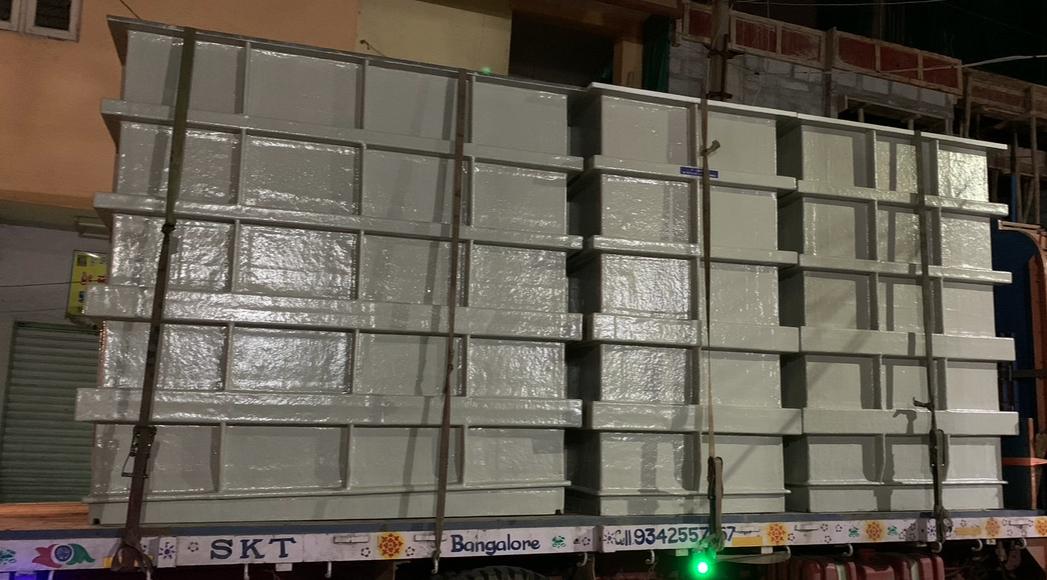 | PVC Tank We are a trusted manufacturer of high-quality PVC + FRP tanks, designed to provide reliable and long-lasting storage solutions for various industrial... View product → |
 | Storage Tank We are a trusted manufacturer and supplier of high-quality PVC Tanks, designed to meet the diverse storage requirements of industrial and commercial... View product → |
How should you operate and inspect a corrosive-service PVC tank?
A chemically compatible PVC tank can still fail from poor support, blocked venting, thermal movement or overloaded nozzles. Treat PVC tank inspection as a structural and process check, not only a corrosion check.
1. Before commissioning, verify the batch or sheet identification, sheet thickness, weld quality, nozzle alignment, support spacing and condition, manways, vent path, overflow route, drain function and level indication. Confirm secondary containment is complete and accessible.
2. Match every connected pipe, gasket, valve and pump to the actual chemical, concentration, temperature and impurities. Do not rest piping on nozzles. Provide flexible movement where thermal expansion could load welded corners; PVC expands roughly 45–80 × 10^-6 per °C.
3. Keep the tank atmospheric and vented. A sealed cover, compressed air, vacuum, blocked overflow or trapped thermal expansion can collapse or rupture it. Use compatible fume capture, protect nearby metalwork from vapour condensation, and keep overflow lines visibly clear.
4. Guard immersion heaters and provide circulation, low-level cut-outs and temperature interlocks. A heater hot spot can discolor, distort or crack the wall even when bulk liquid temperature appears safe.
5. During chemical tank maintenance, inspect for discoloration, distortion, crazing, cracks at corners or nozzles, weld separation, seepage, blistering behind liners, vapour attack on metalwork and UV degradation outdoors. Record concentration, temperature excursions, heater trips and repairs.
Do not specify from the chemical name alone, ignore temperature or impurities, close an unvented tank, or assume an FRP exterior makes every PVC-contact chemical acceptable. Use secondary containment even when no visible leak exists.
Frequently asked questions
What does corrosive chemical handling include beyond storage?
It includes tank venting, compatible piping, pump suction, level control, overflow routing, drainage, spill containment and safe transfer procedures.
How do you verify that PVC is compatible with the chemical?
Check the exact chemical, concentration, temperature and exposure time against a manufacturer’s PVC compatibility chart, then confirm the result with the tank fabricator.
What must be specified so the PVC tank survives its operating loads?
Specify capacity, dimensions, liquid density, temperature, wall thickness, supports, wind or seismic loads, nozzle locations, access openings, vent size and overflow routing.
When should you choose PVC, PVC plus FRP or another tank material?
Use PVC when its chemical and temperature limits fit the service; add FRP for external structural reinforcement, or choose another material when PVC compatibility, temperature or load limits are exceeded.
How should you operate and inspect a corrosive-service PVC tank?
Prevent overfilling, keep vents and overflows clear, avoid unsupported pipe loads, and inspect the shell, seams, fittings, supports and containment for deformation, cracks and leaks.